 |
 |
||||||||||||||||||
|
Installation
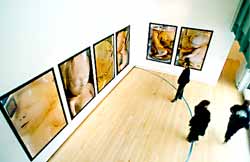
(details) from Still Life. Gallery of Photography, Dublin, Ireland. 1998
|
|||||||||||||||||||
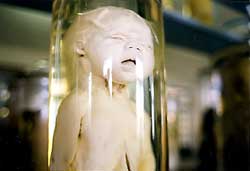
Margrit Shildrick Finding myself in Dublin some time ago, I visited the highly regarded Gallery of Photography to see a new exhibition by Karl Grimes. At the time I was engaged in an archival trawl of 'monster' texts, and had become deeply interested in the richness of representational forms of the monstrous. Still Life records the chance visit by Grimes to the specimen room of an Italian hospital at which he was working on a different project. The exhibition comprised a couple of dozen large photographic portraits of late foetal and neonatal infant bodies with gross congenital deformities, most of whom were preserved in vast glass containers, in some cases after partial dissection. There were several concorporate twins, bodies with hydrocephalus, exposed spines, or other gaping orifices,their corporeal borders dis-integrated. In clinical terms they are monsters, in lay terms freaks. The collection was deeply disturbing: it touched those who saw it. As might be expected, some of the press reviews constructed Still Life as exploitative, voyeuristic, something that should not be put on public show. It was as though the bodies' aw(e)ful vulnerability put us, the viewers, at risk, as though they could contaminate. But that is to miss the point. The encounter with the others who define our own boundaries of normality must inevitably disturb for they are both irreducibly strange and disconcertingly familiar, both opaque and reflective. They enable us to recognise ourselves, they are our own abject. As Grimes himself notes, 'Images of what we have denied turn towards us.' And once the initial shock of confronting what is usually excluded had passed, I found myself not repulsed, but moved to tears by the unaccountable beauty of the bodies. Beyond the marks of a violent and violating science that were evident in the confinement, both materially to specimen jars, and discursively to the category of abnormality, it was possible to acknowledge a siblingship which claims us. How, then, can I theorise these autobiographical moments in the context of contagion and vulnerability? Among the several meanings of the word 'contagion' - all of which are deeply negative in their import - is the notion of a disease spread by touch, or even proximity. We understand that a contaminated object is one to be avoided or kept at a safe distance, lest we too become affected, our bodies opened up to the forces of disintegration. Our well-being, our very lives, are dependent then on the the maintenance of a self-protective detachment, an interval not only between ourselves and evidently dangerous others - be they microbes, parasites, or infected human bodies - but also between ourselves and the mere potential of risk. Contagion is a familiar term in medical discourse; public health, for example, relies, in large part, on the success of epidemiological measures designed not simply to control, but also to avoid the threat of an other that would expose our underlying vulnerability to bodily degeneration... My argument is that in western discourse, the notion of the diseased, the unclean or the contaminated is never just an empirical or supposedly neutral descriptor, but carries the weight of all that stands against - and of course paradoxically secures - the normative categories of ontology and epistemology. In short, as the realisation of a contaminatory threat, contagion can figure any transgression of the categories of sameness and difference, any breach in the unity of the embodied self. As postmodernist theory makes it clear, the self's clean and proper body - to use Julia Kristeva's phrase - is not a given, but instead an unstable construct under constant threat... Extract
from Margrit Shildrick's 'Vulnerable bodies and ontological contamination',
published in: Bashford, Alison (ed). 'Contagion: Historical & Cultural
Studies'. Routledge. London. 2001. Ruane, Medb. 'In Conversation'. Still Life exhibition catalogue interview. Marion McKeone, THE SUNDAY BUSINESS POST, March 29, 1998 |
|||||||||||||||||||
|
|||||||||||||||||||
|
|||||||||||||||||||
|
|||||||||||||||||||
|
www.karlgrimes.net
|
















