
|
still life
Marion McKeone, THE SUNDAY BUSINESS POST, March 29, 1998
On first encountering Karl Grimes' Still Life photographs, my reaction was to recoil in horror. Giant images of deformed babies, some partially dissected, others with layers of skin and flesh missing or falling away from their faces, are initially almost too disturbing to deal with in any rational manner.
Contradictory emotions surge to the surface: these images of new born babies are at odds with what we are used to seeing, an antithesis of proud parents with their bundles of joy, the 'little miracles' that are used to sell everything from cars to nappy wipes.
These monsters to use their clinical title, were removed from any human context. Collections of congenital malformation specimens were used for research in universities and teaching hospitals from the 19th century onwards. They float eerily in jars, pickled in formaldehyde. Their deaths were caused by various medical abnormalities: some have two heads, many others suffered from hydrocephalus. Some nestle gently in the jars, others have their heads forced up against the glass, hands tied behind their backs.
Grimes, who has had a longtime interest in the asymmetry of nature, happened on the dead babies while photographing medical procedures in a hospital in Milan. He is one of the few photographers whose work makes a seamless transition to art, interpreting humanity rather than reproducing it. There is an ethereal quality to much of his work and in Still Life this is most pronounced.
Far from dehumanising these dead babies, Grimes gives them an identity. These portraits contain no pro or anti-choice statements. Rather, they force us to confront our horror of any human form that deviates from the norm. They lead us to question our obsession with traditional notions of beauty and normality. Because, just as there are icons of beauty and glamour, these portraits are icons of dread, abnormality, freakishness. It is these abnormalities which redefine the boundaries of normality.
As Grimes says, their very nature is crucial to how we recognise ourselves. Just as criminals and social deviants are a societal necessity in the definition of the boundaries of acceptable behaviour, to reinforce our moral standards, physical abnormalities define our idea of normality.
Grimes has gone beyond the the freakish connotations that traditional perceptions of beauty and perfection give to his subjects. He has succeeded in giving them a dignity, in making them individuals rather than a row of unsavoury medical specimens shoved in a basement. This type of artistic endeavour is a very, very risky one. In the wrong hands, it could become an exploitative, futile exercise. Certainly it is shocking and deeply disturbing. But when the initial shock subsides, there is a soothing quality, a strange beauty, to these portraits.
Still Life is thoughtfully and intelligently curated. Technically, the portraits are exquisite, the colour and quality of reproduction faultless. The artist's statement and the outside of the jars are the first aspect which visitors encounter. Then they are confronted by huge portraits which fill the frame without showing the confines of the glass jars. Upstairs, the portraits are smaller, the lines more defined. There are no titles.
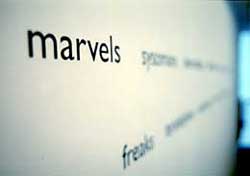
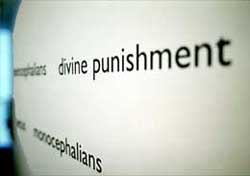
When Grimes discovered the jars, they had no identity save the medical condition which was written on the outside of the jar. Words commonly used to describe congenital abnormalities - freak, monster, omen - are interspersed along one wall. Some are unbearably poignant. In one a baby appears to gaze peacefully into the distance, it's chin nesting against a bed of gauze; a tiny hand appears to hold a ring, like a rattle, in another. In a more harrowing portrait, a hair curls over an ear. Above it, the top of the skull has been brutally severed. A two-headed baby's mouths and faces turn towards each other lovingly. In another, the hands are tied behind the back with a ribbon.
There is a gentleness to his work, a non-intrusiveness which is in marked contrast to the brutally invasive procedures carried out by the medical profession which dehumanised them.
This exhibition is the Gallery of Photography's most controversial, and ultimately rewarding to date. Still Life is perhaps the most disturbing and profoundly moving exhibition I have seen in Dublin. If art is about communication, about pushing back the boundaries, about challenging deep-rooted prejudices and traditional perceptions, then this is art in its purest form.
Marion
McKeone
Reproduced from THE SUNDAY BUSINESS POST, March 29, 1998.
|
|
OTHER
REVIEWS
Schildrick, Margrit .'Touching the Monster: Encounters with the Vulnerable Self'. Sage. London. 2001
Armstrong, James. 'Still Life'. Source, Vol # 4, p.34. 1998
Ruane, Medb. 'In Conversation'. Still Life exhibition catalogue interview.
Circa. 'No Comment'. Circa, No 84 Summer, pp.6-7. 1998.
Bashford, Alison (ed). 'Contagion: Historical &
Cultural Studies'. Routledge. London. 2001
Lovett, Marian. 'Karl Grimes: Still Life', The Sunday Times, April 5, P.23. 1998
McBride, Stephanie. 'Karl Grimes: Work in Process'. Circa, No 81, pp.35-42. 1997
In Dublin. 'Little Budda'. In Dublin, Vol 23, No 7, April 1998
Collins, Mark. 'The Grimes Reaper'. Temple Bar Review, April 1998
O'Reilly, Ronan. 'Enough to make you weep'. The Sun, March 28, cover, P1/2. 1998
Donaghy, Kathy. 'How low can you sink'. The Sun, March 27, cover, P1/2/8.
1998
 |
 |
 |













